Beyond Difficult Behavior: Seeing and Responding to Trauma in Family Law and Dependency Court Mediations

Hi Everyone,

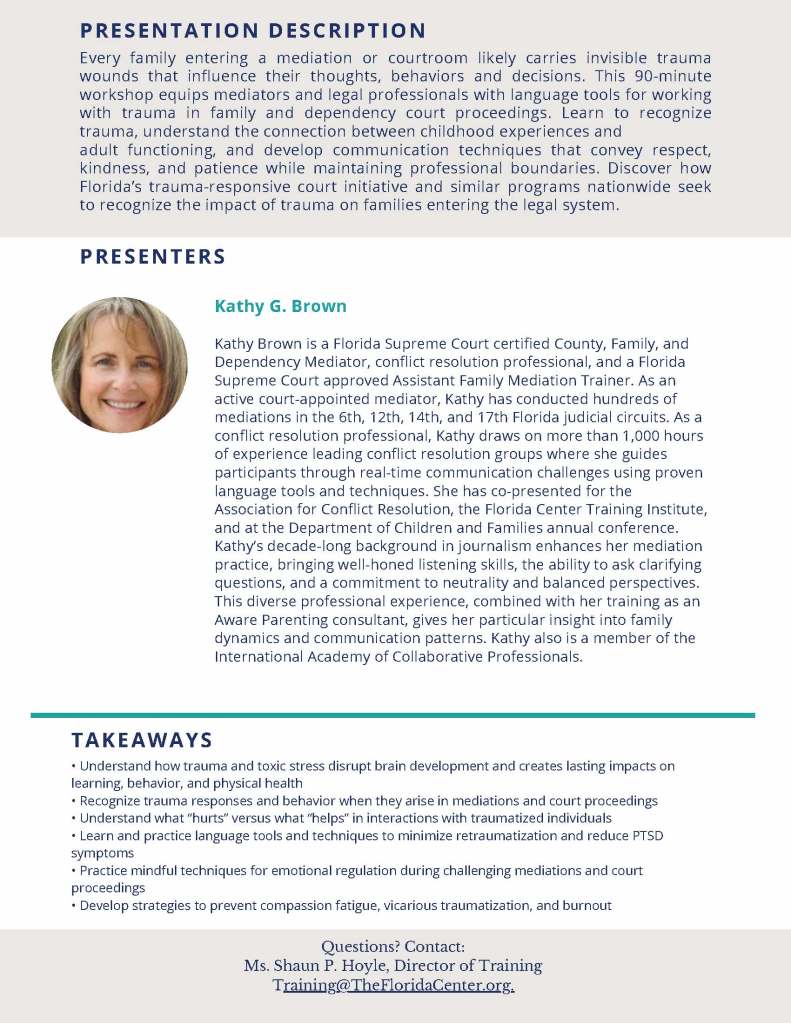
I’ll be giving a virtual workshop this Friday, Oct. 24, 2025, for The Florida Center Training Institute on “Beyond Difficult Behavior.” 

Below is the information, and I’ve attached the flyer….if you’re interested in this topic I’d love to see you there!  

Description:

Every family entering a mediation or courtroom likely carries invisible trauma wounds that influence their thoughts, behaviors and decisions. This 90-minute workshop equips mediators and legal professionals with language tools for working with trauma in family and dependency court proceedings. Learn to recognize trauma, understand the connection between childhood experiences and adult functioning, and develop communication techniques that convey respect, kindness, and patience while maintaining professional boundaries. Discover how Florida’s trauma-responsive court initiative and similar programs nationwide seek to recognize the impact of trauma on families entering the legal system. 

Takeaways:

* Understand how trauma and toxic stress disrupt brain development and creates lasting impacts on learning, behavior, and physical health. 

* Recognize trauma responses and behavior when they arise in mediations and court proceedings. 

* Understand what “hurts” and what “helps” in interactions with traumatized individuals.

* Learn and practice language tools and techniques to minimize retraumatization and reduce PTSD symptoms. 

* Practice mindful techniques for emotional regulation during challenging mediations and when working with families in crisis. 

*Develop strategies to prevent compassion fatigue, vicarious traumatization, and burnout. 

Managing the Negotiation Within: Internal Family Systems Workshop for Mediators, Lawyers, and Other Professionals

Early-bird pricing extended!


Boston Law Collaborative and Relationship Conflict Resolution invite you to a training led by mediator and attorney David Hoffman, Lecturer on Law at Harvard Law School

WHEN: Friday, January 19, 2024 (9 a.m. – 5 p.m.) and Saturday, January 20, 2024 (9 a.m. – 1 p.m.)

WHERE: St. Petersburg Conference Center, 8950 Dr. MLK Jr. St. N., Suite 160, St. Petersburg, FL 33702

WHO SHOULD ATTEND: Mediators, lawyers, and other professionals who deal with conflict.

WHAT: Twelve-hour advanced training involving the theory and practice of the Internal Family Systems model as a tool for conflict resolution, with simulations and written materials.

COST: $345, early-bird price, $395 regular price.

HOW TO REGISTER: RSVP to Kathy Brown at RelationshipConflictResolution
@gmail.com
. Or call Kathy at (727) 608-3086. Please give your name and email.

PAYMENT for the workshop can be made via PayPal or Eventbrite. Space is limited to 25 participants.

(Reduced registration fee available in the event of financial need. To inquire email Kathy.)

CMEs are available; CLEs (11 credits) have been approved.

Successful conflict resolution is much more than dealing with the personalities involved: it requires preparation, knowledge, practice and a proven model.

The Internal Family Systems model (IFS) that has helped professionals in mediation, arbitration, academic administration, life coaching, and other professions dedicated to resolving conflict — and is rapidly building a following within the field of dispute resolution — is now available to you to help inform and guide your work … and your life.

Built on the principle of empowerment, IFS helps you better understand where your triggers are, work with them, so you’re not so reactive, and then help others to do the same.

IFS is one of the most powerful tools today to help us better understand human interactions and to remind us that our role as mediators is not about ourselves, but about helping people find their own solutions.

This program will provide participants with an in-depth opportunity to learn and work with the IFS model in the conflict resolution setting. No prior IFS training is needed.

In this two-day workshop, you will learn:

  • An overview of the IFS model: Demonstration and Discussion
  • How to apply the model: Role playing
  • Ways to access “Self” energy
  • How to apply IFS when working with people

Find your mediator within. Better understand the sources of implicit bias.

Agenda (see below for speaker bio)

Day One

  • Welcome, Introductions and Overview of the Training
  • Introduction to the IFS model: Demonstration and Discussion
  • How to apply the model: Role play 1 – Working One-on-One with Clients
  • Plenary Debrief
  • Accessing “Self” Energy: The Self-Led Mediator / Lawyer / Collaborative Professional

Day Two

  • Applying the IFS Model when Working with Two People
    (Demonstration and Discussion)
  • Small Group Role Play Sessions
  • Plenary Debrief
  • Q & A and Concluding Remarks

Seating is limited. Sign up today!

Faculty Bio

David Hoffman, Esq., is an attorney, mediator, arbitrator, and founding member of Boston Law Collaborative, LLC. He is also the John H. Watson, Jr. Lecturer on Law at Harvard Law School, where he teaches three courses: Mediation; Legal Profession: Collaborative Law; and Diversity and Dispute Resolution.

David uses IFS techniques in his work as a mediator and lawyer and has published an article about IFS in the Harvard Negotiation Law Review, “Mediation, Multiple Minds, and Managing the Negotiation Within.”

As mediator and arbitrator, David has handled over 2,000 cases involving business, family, employment, and other disputes. David is past chair of the ABA Section of Dispute Resolution, a Distinquished Fellow in the International Academy of Mediators, and a founding member of the Massachusetts Collaborative Law Council. He is listed in the book, “Best Lawyers in America,” in six categories, including mediation, arbitration, and Collaborative Law. He has received lifetime achievement awards from the Association of Professional Family Mediators and the American College of Civil Trial Mediators and the D’Alemberte-Raven Award, the ABA Section of Dispute Resolution’s highest honor recognizing outstanding service in the field.

David has published three books on dispute resolution: Mediation: A Practical Guide for Mediators, Lawyers, and Other Professionals (Massachusetts Continuing Legal Education 2013); Bringing Peace into the Room: How the Personal Qualities of the Mediator Impact the Process of Conflict Resolution (with co-editor Daniel Bowling); the Massachusetts Alternative Dispute Resolution (with co-author David Matz) – and numerous articles, which are posted on the Boston Law Collaborative, LLC web site.

Prior to founding Boston Law Collaborative, LLC in 2003, David was a partner at the Boston law firm Hill & Barlow, where he practiced for 17 years, in the areas of family law, employment law, commercial litigation, and alternative dispute resolution. Before that, he was a clerk for Hon. Stephen G. Breyer, when he was on the U.S. Court of Appeals for the First Circuit.

David is a graduate of Princeton University (A.B. 1970, summa cum laude), Cornell University (M.A. 1974, American Studies), and Harvard Law School (J.D. 1984, magna cum laude), where he was an editor of the Harvard Law Review.

David lives in a cohousing community in Acton, Massachusetts with his wife, Leslie Warner, who is a career coach; between them they have five adult children, a rescued Golden Retriever from Serbia, and an adolescent cat.

Boston Law Collaborative, LLC provides mediation, arbitration, and dispute resolution services, as well as legal representation in court and in Collaborative Law cases. For more info, please visit http://www.BLC.law.

The BLC Institute is a non-profit devoted to providing training and education in all aspects of dispute resolution. To learn more about the Institute and upcoming programs, visit https://blc.law/training

BLC has won the American Bar Association’s Lawyer as Problem Solver Award, and the Law Firm Award for Excellence in ADR from the International Institute for Conflict Prevention and Resolution.

Helping parties navigate conflict using a “parts” language and framework

During disputes, strong emotions can often derail the communication process and impair relationships by impacting how we communicate.

How we communicate during a conflict affects how the other party hears us. To resolve conflict, parties must feel heard so solutions can occur. Feeling heard is the function that moves us out of conflict and on to the path of resolution.

As a mediator, I use a “parts” language and framework as one of my main tools to help parties hear each other better. This method draws on our natural instinct to describe what’s going on inside us. And it offers a safe way to speak for intense emotions and to give voice to mixed feelings.

For example, in the course of any given day we may think or say, “Part of me feels this way, but part of me feels that way.” Or, “On the one hand, I like where we’re going with this, but on the other, I’m concerned we’re not addressing a key component.” Or, “Part of me wants to share my experience, but another part of me worries I’ll be embarrassed.”

In short, the tool helps the listener to not hear blame, because the framework helps the speaker phrase things in a way that opens up space for a more calm and curious view of the issues. When this happens, solutions often arise spontaneously.

Although some mediators might include this language as part of their skill set, many more can benefit from understanding how effective the framework is for both mediators and the parties we work with.

This language and framework is formalized in a tool called Internal Family Systems (IFS), a highly effective psychotherapy model that also helps to manage disagreements.    

Using the IFS techniques, I help parties to identify and speak for the fearful, angry or wounded parts of themselves that are driving the conflict. Once these parts are witnessed, the parties often become more relaxed. And they’re more open to talking about the situation with a sense of genuine concern and curiosity. 

The benefits of using IFS in mediations and negotiations became clear to me at a 2017 training I attended in Boston. It was led by attorney and mediator David Hoffman, and psychologist Dick Schwartz, the developer of the IFS model. 

Hoffman is the founding member of the Boston Law Collaborative Institute, and Lecturer on Law at Harvard Law School. For more than 10 years, he has been using IFS techniques in his mediation and law practice. He says IFS has enhanced his ability to mediate cases. But, he adds, not all lawyers and mediators are enthusiastic about the tool. The ones who are tend to be more psychologically oriented.

“For most lawyers, psychology and emotional intelligence are not part of their standard training and therefore uncomfortable. Law, as it is currently practiced by most lawyers is a decidedly left-brain enterprise,” he says.

“For the lawyers and mediators drawn to IFS, I think the impetus is three-fold. First, there’s a recognition that we need to know what makes people tick to be effective. Second, IFS is a uniquely non-pathologizing, intuitive model that can be readily grasped without having a deep knowledge of psychoanalytic or psychodynamic theory. Finally, IFS provides mediators and lawyers with valuable tools for self-understanding, self-compassion and self-management.”

Mediating using the IFS model

Created by Schwartz in the 80s, IFS postulates that we are all made up of parts. This concept isn’t new. Freud stated that the mind consists of three parts: the id, the ego, and the superego, at the turn of the 20th century.

IFS takes the idea a little further. It contends that it’s the natural state of the mind to be divided into many parts or subpersonalities. The model asserts these “parts” have different thoughts, feelings and beliefs. And they interact with each other much like the interactions of family members.

Taking this approach to the mind can be very helpful. Hoffman elaborates on this in a 2011 article in the Harvard Negotiation Law Review. The article is titled, “Mediation, Multiple Minds, and Managing the Negotiation Within.”

“The concept of parts allows the mediator to inquire as to whether there are other parts with differing goals and agendas— thus providing the parties with a psychologically safer way to express the full range of emotions they may be experiencing — and to consider loosening their commitment to strongly held positions. This technique also provides the mediator and the parties with an easily understandable vocabulary for communicating about ambivalence.”

In IFS, “parts” fall into three categories or roles as a result of trauma. They are: Managers, Exiles, and Firefighters.

Managers are parts who protect a person from past pain or from being hurt by others. They take on roles such as an inner critic, a pleaser, an organizer, a judge or an intellectual.

Exiles are often young parts who have experienced pain, shame, fear or trauma. Usually these are from experiences that happened in childhood. But they’re still unresolved because there were no resources at the time for the young parts to heal.

The jobs of the managers and the firefighters are to prevent the pain of the exiles from coming to the surface. Because if that happens, a person’s system could become overwhelmed with emotional pain.

Firefighters are parts with extreme behaviors. They come on the scene when the managers have been unable to stop the exile from emerging. The firefighter parts work to numb, dissociate, or distract a person’s attention away from the hurt or shame of the exile. They’re often associated with addictive behaviors. Some of which are overeating, drug and alcohol abuse, violence, sex addiction, overworking or over-medicating.

Besides the three categories, the model contends that at our core is what IFS calls the Self. This Self is innate in all of us, and contains 8 characteristics, which IFS refers to as the 8 C’s. They are:

Calmness
Curiosity
Compassion
Courage
Clarity
Confidence
Connectedness
Creativity

These are all traits that can benefit a mediator in the midst of conflict. 

As Hoffman and Schwartz state, when mediators are Self-led, it’s contagious. Coming from a more centered, open and curious place, mediators can then help the parties do the same.

Schwartz explains how lawyers and mediators can apply the IFS model to mediation.

“When people are in conflict, they are often hijacked by parts of them that see the other as trying to exploit, dominate, or hurt them. Consequently, they act in ways that trigger the protective parts of the other and things escalate,” he says.

“When a mediator can help each part find, listen to, and then ask their protectors to ‘step back’ inside, they access a very different aspect of the person who can see the other and the issue with qualities like clarity, confidence, calm and even compassion. IFS calls this state Self. When the mediator can hold each party in Self leadership, creative flexible solutions emerge naturally.”

It’s important to note the difference between IFS psychotherapy and IFS mediation. IFS therapy helps to release the Managers, Exiles, and Firefighters from their extreme roles so they can choose new ones that support a person’s emotional healing. IFS mediation employs a more limited use of the model. As Schwartz states, in IFS mediation, the goal is to help the parties’ protector parts step aside temporarily so the parties can be Self-led with characteristics such as curiosity and compassion.

I’ve found that often just having the triggered parts acknowledged and witnessed by others opens up space for Self to emerge, which has a profound effect on putting the parties on the path to resolution. 

If you’re looking for a mediator and you’re interested in experiencing the IFS language and framework as part of the mediation process, please contact Kathy at relationshipconflictresolution@gmail.com to schedule a free consultation.

Practice diffusing conflict using Nonviolent Communication (NVC)

Hello! I’m facilitating a 5-week Nonviolent Communication (NVC) practice group at the St. Petersburg College/Gibbs Campus Library starting Tuesday, Aug. 27, 2019, from 7 to 8:30 p.m.

This practice group is an opportunity to immerse yourself in a needs-based communication model (NVC) that can turn stressful conversations into mindful resolutions.

As a family mediator and founder of Relationship Conflict Resolution, I’m offering this 5-week class for those interested in enhancing their ability to communicate from the heart. I’ve been using NVC in my personal and professional life for nearly 20 years. The compassionate communication model is magical in its ability to restore and deepen relationships, and resolve conflicts from a calmer, more mindful space.

We will meet at the St. Petersburg College Library on Tuesdays, from 7 to 8:30 p.m., beginning Tuesday, Aug. 27, 2019. The 5-week class runs through Tuesday, Oct. 1, 2019, with no group on Tuesday, Sept. 17, 2019. The college library is located at 6700 8th Ave., N., St. Petersburg, FL, 33710.

No prerequisites required.

Everyone is welcome. All classes at the library are free. We will meet in conference room LI-101, first door on the left after entering the library.

In this practice group, we will distinguish:

* empathy from non-empathetic forms of response

* self-empathy from acting out, repressing or stewing

* non-judgmental forms of expressing and receiving gratitude from judgmental forms

I will also demonstrate how to integrate other models with NVC, specifically the Internal Family Systems (IFS) model.

At the end of each class, I’ll mediate a real-life conflict using NVC. You’re welcome to bring a conflict of your own for the demonstration.

The first person who brings a friend will receive a Feelings and Needs card deck, and a private session on how to use the cards.

If you feel motivated, please join us as we have some fun supporting each other in learning a language that inspires compassion and collaboration!

To register, please click on the link below and you will go to the event posted on my Relationship Conflict Resolution Facebook page.

https://www.facebook.com/events/488231478618661/?event_time_id=488231491951993

NVC Practice Group

Hi Everyone!

I’m starting a Nonviolent Communication (NVC) Practice Group at the St. Petersburg College Library on Tuesdays, from 7 to 8 p.m. In our practice, we will distinguish Judgments from Observations, Thoughts from Feelings, Strategies from Needs, Demands from Requests, and have some fun.

The 5-week practice group begins Tuesday, May 21, 2019, and runs through Tuesday, June 25, 2019. There will be no group on Tuesday, June 4, 2019.

Everyone is welcome. All classes at the library are free. The practice group will meet in room 223 on the second floor.

No pre-requisites are required.

The library is located on the St. Petersburg College Gibbs Campus at 6700 8th Ave., N., St. Pete, FL, 33710.

The first person who brings a friend will receive the latest NVC book by founder Marshall Rosenberg.

If you feel inspired, come learn and practice a language that can transform the way you look at things!


New Workshop: Going Inward to Heal & Enrich Relationships

goinginwardpath

Are you afraid to say what you’re really feeling and needing in your relationships?

When you do express what’s going on inside of you, do you walk away from the experience feeling frustrated and not heard?

Are you wanting a deeper connection with those who matter most to you, but you’re not sure how to go about it?

Fostering mutually respectful relationships isn’t easy.

It’s challenging because pre-existing negative thoughts, feelings and beliefs are triggered in our everyday interactions. When this happens our neurological systems overloadwordsbecome overloaded with stress hormones.

This can cause us to lose touch with the more calm state we may have been in previously, and can propel us to react from a place of fear, anger or hurt. Doing so can erode and eventually destroy relationships.

Many people think the solution to getting triggered is to control their environment and the people around them. 

But the most effective solution is going inward.

When we acknowledge our negative thoughts, feelings, and unmet needs, it gives us the opportunity to tend to our internal conversations and restore our central nervous system.

When we focus on clarifying what is being observed, felt, and needed, we open up space to discover the power of our own compassion.

Using the techniques taught in this workshop it’s possible to meet many of our own emotional needs.

We can then come to our relationships more whole, healed and ready for an exchange at a new level of authenticity.

Join Kathy as she uses Nonviolent Communication (NVC) and the Internal Family Systems (IFS) model roundtableto show participants how to get in touch with their inner council’s feelings and needs, and how to tap into that place of calm, compassionate acceptance within us all.


Format: This online group meets via Zoom video conferencing. The two-hour format will include an instructional portion and a demonstration. Participants also will be paired up each week to practice the skills with each other.

When: Mondays 1 p.m. to 3 p.m. EST.

Length: 5 weeks, April 23 – May 21, 2018.

Pre-requisite for course: Print card deck (108 cards). Feelings, Needs and Choices, $15. Buy it here.

Cost for workshop: $180, $150 if enrolled by April 16, 2018.

To sign up or if you have questions, contact Kathy.